

Enterprise AI is entering a new phase. The early wave of experimentation was dominated by chatbots, coding assistants, and isolated proofs of concept. The next wave is different. Organizations now need AI agents that can safely act on enterprise data, understand business context, integrate with core systems, and operate within clear governance boundaries.
That shift changes the platform conversation. Success is no longer determined by the smartest model alone. It depends on whether an organization can expose the right data, provide trustworthy context, orchestrate workflows, manage security, preserve sovereignty, and keep architecture coherent while AI accelerates delivery. This is where the OutSystems platform is strongly positioned. It combines access to diverse data, enterprise integration, agentic development, governed orchestration, and production-grade controls in one unified environment.
Data Is the Foundation of Useful Enterprise AI
AI agents are only as useful as the data they can access and the context they can understand. In many enterprises, valuable information is spread across ERP systems, CRM platforms, databases, document repositories, legacy applications, cloud services, and departmental tools. This fragmentation limits AI adoption because every agent or application needs its own integration logic, its own security model, and its own interpretation of business meaning.
OutSystems Data Fabric
OutSystems Data Fabric addresses this challenge by creating a virtual data layer across structured and unstructured enterprise data. Instead of moving everything into a single physical repository, it makes data discoverable, reusable, and accessible through a consistent abstraction layer. For enterprise AI, that matters because agents need grounded, real-time, business-specific information without creating a maze of custom integrations and duplicated pipelines.
Data Fabric can connect applications and agents to enterprise data sources such as SAP, Salesforce, Microsoft Dynamics 365, SQL Server, Oracle, MySQL, IBM Db2, PostgreSQL, MongoDB, cloud-native databases, and emerging analytical platforms such as Snowflake. The result is not just connectivity; it is a reusable data access layer that can serve multiple applications, workflows, and AI use cases.
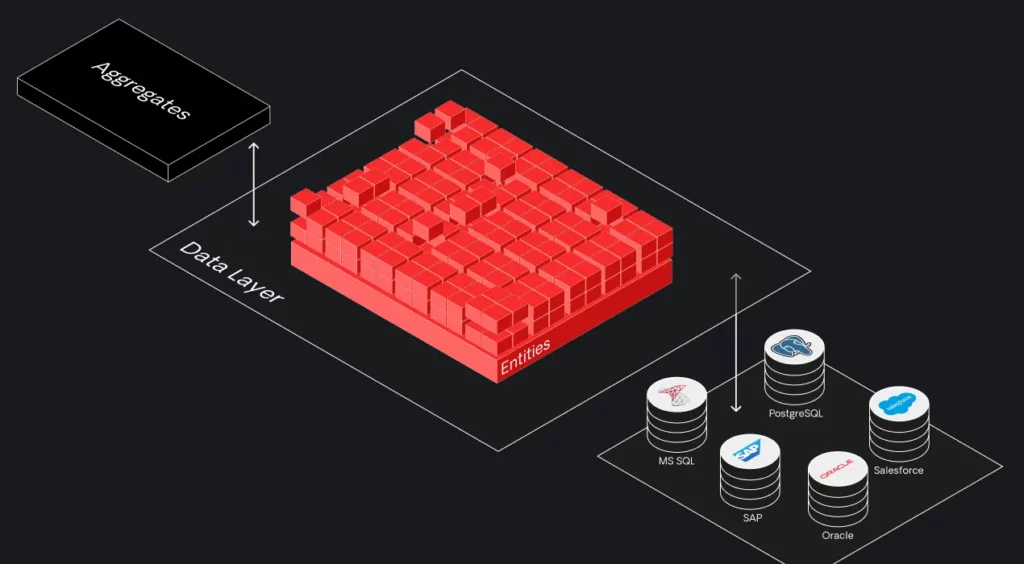
Instead of building isolated API calls for every business request, data engineers and developers can expose consistent datasets, define reusable access patterns, support role-based visibility, and enable teams to consume trusted data faster.
Semantic search further strengthens the AI use case. OutSystems helps agents retrieve relevant context based on user intent rather than exact keyword matches.
Enterprise Context Graph
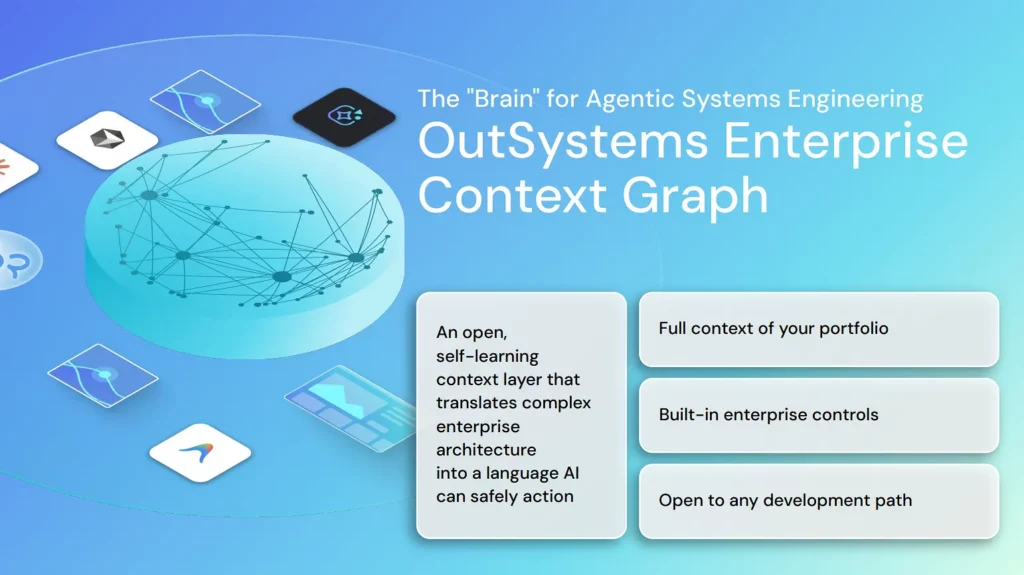
The OutSystems Enterprise Context Graph is important because it gives AI agents and development teams a living model of the enterprise software estate. It connects applications, data models, business logic, workflows, dependencies, and governance policies into a form that can be used by both humans and AI-assisted tools. This means agentic development is not treated as a disconnected layer on top of the enterprise. It becomes part of a governed application architecture.
Mentor, the agentic app generation experience, builds on this context. Teams can describe what they need in natural language, validate a blueprint of entities, relationships, screens, roles, and workflows, and then continue development in the IDE.
Control, Sovereignty, and Business Impact
For C-level executives, the central question is no longer whether AI can produce impressive demos. The question is whether AI can be deployed safely, economically, and repeatedly across mission-critical business processes. OutSystems is positioned around exactly that challenge.
The platform supports digital sovereignty by giving organizations flexibility over deployment and AI workload placement. It helps reduce cost uncertainty by allowing teams to optimize models, tools, workloads, and delivery patterns. It also protects strategic control by keeping proprietary business logic, data, and context separate from dependency on any single AI provider.
Equally important, OutSystems brings compliance, aligning with standards and regulations such as SOC 2 Type II, ISO 27001, ISO 22301, GDPR, the EU Data Act, the EU AI Act, HIPAA, and PCI DSS.
From AI Pilots to Enterprise-Scale Agentic Operations
The real opportunity for enterprise AI is not in generating more standalone apps or isolated copilots. It is in creating agentic systems that can act across business processes, use trusted data, respect governance rules, and continuously evolve with the enterprise architecture. That requires more than model access. It requires a platform that understands data, applications, workflows, security, and lifecycle management as one connected system.
OutSystems is optimally positioned because it brings these elements together. Data Fabric makes enterprise data easier to access and reuse. Semantic search improves contextual retrieval for AI agents. The Enterprise Context Graph gives agents and developers a structured understanding of the software estate. Mentor accelerates application generation while keeping teams aligned with the enterprise model. Together, these and other components form the OutSystems Agentic Systems Platform for Enterprise AI.
The Bottom Line
AI agents need access to the right data, but that access must be secure, governed, reusable, and architecturally sound. Enterprises need openness, but not at the expense of sovereignty or control. They need speed, but not at the expense of maintainability or compliance.
With the OutSystems Agentic Systems Platform, teams can build with their preferred agentic coding tools, orchestrate AI agents, apps, and workflows across the enterprise, and govern the entire lifecycle in one place.
Onno Poelmeyer, Consultant, CoolProfs