

Developer Productivity
Lately, I have been looking at a lot of videos about developer productivity. How to measure it, how to enhance it, and how AI can play a role in this quest. There is a reason for that, of course. Our clients are starting to ask questions about it. And CoolProfs has responded to the demand by organizing a Cool Pop-Up, a customer and OutSystems community event. Two of our developers held a presentation about enhancing developer productivity with AI.
There was not enough time in this presentation to also talk about measuring developer productivity. Or if you should even do that. That’s why this blog was created. So let’s dive into it!
Measuring team and developer productivity
The first question to ask is: “Can you actually measure the productivity of a team, or even an individual developer?” The next question should be: “Do you actually want to measure that?” Because measuring productivity may lead to setting expectations, or goals. And that can send the wrong signal to your development teams. Or even convince management that software development productivity is just a metric that you can glance off a dashboard.
To answer the first question: yes, you can measure software developer productivity. At least according to McKinsey & Company. In a nutshell, their approach builds on the foundation of existing productivity metrics in the software industry. We’ll get into those soon.
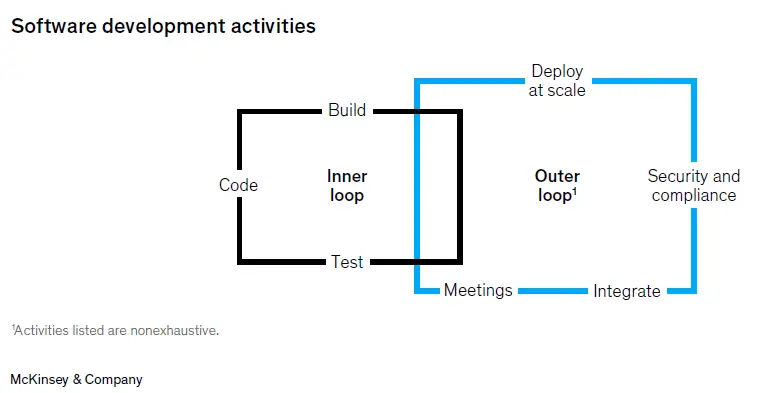
But first, the risks. Let’s say that an organization attempts to measure the productivity of their software development teams. And let’s say that one metric is deployment frequency. Then there is always a chance that teams will try to game the system. In other words, if deployment frequency is ‘what they want’, the team can deploy code several times a day. But is that really useful?
Another risk is comparison. It may be unwise to compare teams to one another. They may be working on very different apps of have different priorities. For instance, one team may be cleaning up a lot of technical debt, which may not lead to great productivity now, but will benefit the organization later on.
Another pitfall could be management’s desire to capture everything in one statistic or number. Complex environments cannot be captured this easily.
DORA Metrics
There are two rather well-known methods for measuring developer productivity. One of them is DORA (DevOps Research and Assessment). This long-running research program was developed by Google Cloud. Its metrics are:
- Deployment Frequency: How often code is released to production. Higher frequency indicates a strong CI/CD pipeline and an agile team.
- Lead Time for Changes: The time it takes for code to go from commit to production. Shorter lead times are better, indicating faster delivery of updates and features.
- Change Failure Rate: The percentage of deployments that cause problems. A lower rate indicates reliable systems and effective testing.
- Time to Restore Service: The time it takes to fix issues when they occur. Faster recovery times indicate better incident management.
The SPACE Framework for Developer Productivity
The SPACE framework, introduced by Dr. Nicole Forsgren, offers a holistic approach to measuring developer productivity. It consists of five dimensions:
- Satisfaction and Well-being: Developers’ satisfaction with their work and tools. Higher satisfaction often correlates with higher productivity.
- Performance: The outcomes of work, such as code quality.
- Activity: Quantitative measures like the number of pull requests and commits.
- Communication and Collaboration: How well developers work together and communicate.
- Efficiency and Flow: Basically, the ability to work with minimal interruptions or delays.
The SPACE framework emphasizes that productivity is not just about individual performance, but also about team dynamics and overall well-being.
Enhancing developer productivity – the basics
One video I watched on the subject of developer productivity was titled “The SECRET To Improve Developer Productivity Is… Being HAPPY?” And yes, there is a good point in there. Lots of research indicates that happier people tend to be more productive. This also ties in with the satisfaction and well-being dimension of the SPACE framework.
So, do you give developers free snacks and pat them on the back a lot? Although that won’t hurt, the general consensus is that you can make developers (and teams) happier by:
- Optimizing workflows: Implement CI/CD pipelines and automate deployment processes to reduce lead times and increase deployment frequency.
- A positive work environment: Ensure developers have the tools and support they need to be satisfied and productive. Address frustrations like long build times and error-prone tests.
- Uninterrupted work: DevEx (developer experience) is a thing now. DevEx encompasses how developers feel about, think about, and value their work. An important aspect for productivity is to let them get into the flow and minimize interruptions.
- Automated tasks: Use (AI) tools to handle mundane tasks like generating test cases and documentation, freeing up developers for more creative work.
Enhancing developer productivity – leveraging AI
How can we leverage AI to make developers more productive? The answer depends on the environment. AI tools such as Claude Code or GitHub Copilot help developers write code faster and hopefully better. AI is also great at generating test cases and such.
Developers using low-code tools such as OutSystems do not profit from this development in the same way. They are already highly productive at creating code, because the low-code platform does it for them. However, generative AI such as Copilot or ChatGPT can still make a big difference in developer productivity. The secret lies in how you use these tools. Here are a few tips:
- Get a paid version of Copilot or ChatGPT, so that employees can work securely and not worry about data being used to train AI models and such.
- Research and planning phase: have AI do market research or compare other software products. Have it generate a project planning.
- Design and architecture phase: have AI choose good color swatches, design wireframes, or propose a database scheme.
- Development phase: have AI describe an API integration, optimize an SQL query, generate some CSS to add to a theme
- Testing phase: as long as AI cannot actually test your app, describe the project and ask it to describe and prioritize test cases.
- Documentation: have AI generate a user manual, API documentation, or FAQs. It could even write the script for an instruction video.
Conclusion
It is possible to measure team and developer productivity by adopting frameworks such as DORA and SPACE. However, care must be taken to introduce this well. Remember, you will not gain anything from developers gaming the system or them becoming unhappier. Just the opposite – a happy developer is a more productive developer!
AI has the potential to significantly enhance developer productivity by automating repetitive tasks and helping out with ideation or optimization. If you have say 10 developers, and they each save 1 hour a week (and are happier), it adds up!
I mentioned at the start that CoolProfs held a community event presentation about enhancing developer productivity with AI. It was received with great enthusiasm. No, there is no recording. But if you would like to know more about how CoolProfs can help you and your teams by leveraging AI, let’s talk.
Onno Poelmeyer, Consultant, CoolProfs