

Monitoring and data analysis with AI
In a world where digital platforms form the backbone of business operations, it’s crucial that developers, administrators, and business users have insight into what’s happening within their systems. Especially with low-code platforms like OutSystems—where speed and simplicity are key—monitoring should never be a limiting factor.
Until now, effective data analysis has required deep knowledge of both data and OutSystems. To accelerate and democratize data analysis, we at CoolProfs have started building an AI assistant in Elastic. By integrating logging and metrics from the OutSystems platform along with documentation from applications, OutSystems, and data models, we’ve developed a smart assistant that not only makes monitoring more efficient, but also more accessible to everyone on the team.
Pillars
A solid monitoring strategy for OutSystems and other software systems rests on three pillars: application logs, machine metrics, and transaction data. Application logs contain error messages, system warnings, and other important information from the OutSystems modules. Machine metrics provide insight into the performance of the underlying infrastructure, such as CPU usage, memory load, and network activity. Finally, transaction data reveals how the application is being used, such as user sessions, API calls, and screen performance. By combining these three data streams in Elastic, a complete picture of the environment emerges.

Extracting Value from Data
Elastic is ideally suited to collect, store, and analyze this data. The platform is scalable, fast, and offers extensive functionality for dashboarding, machine learning, and alerting. But even with all these capabilities, it can be challenging for less technical colleagues to extract value from the data. Not everyone knows what’s in the logs and metrics, how the data is connected, or what features Elastic offers. This is where the AI Assistant comes in.
AI Assistant
The AI Assistant is a generative AI interface built on top of Elastic, which translates natural language questions into technical search queries. Instead of writing complex queries, users can simply ask questions like: “Why have there been more 500 errors in the UserService module since this morning?” or “Which users are causing the highest memory usage?” The AI interprets the question, searches the relevant data streams, and returns an answer—often with suggestions for visualizations or follow-up questions. Using the AI Assistant significantly lowers the barrier to working with monitoring data.
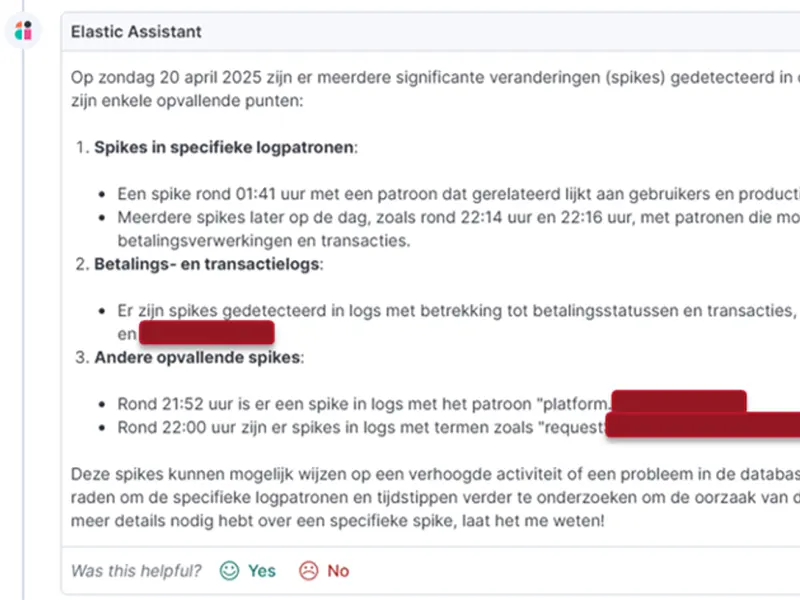
Example
A concrete example: suppose a user reports that the application is slow. In the past, an administrator would have to dig through dashboards, write queries, and hope to find something. With the AI Assistant, they can simply ask: “When did screen load times for the CustomerPortal module start increasing?” The assistant analyzes trends, compares log data, and might respond: “Since 9:43 this morning, the average load time of CustomerPortal.HomePage has increased from 250ms to 900ms. This coincides with a spike in warnings from the CustomerSyncService. Would you like to analyze this further?” This allows the administrator to immediately take action, identify correlations, and respond effectively.
Benefits
The benefits for the organization are substantial. First, monitoring becomes more accessible to colleagues without a technical background. Functional administrators, testers, and even business analysts can now ask the system questions themselves. This saves time and reduces dependency on technical teams. Second, analysis and troubleshooting are faster, as AI immediately suggests relevant correlations. Incidents can be resolved more quickly—or even prevented. Third, it promotes knowledge sharing. Beyond logging, other topics can also be queried. Documentation can be loaded into the assistant’s knowledge base and queried as well. The AI can suggest next steps, show relevant documentation, and compare documents.
Conclusion
The AI Assistant fundamentally changes how we approach monitoring. By combining natural language with the power of Elastic, the depth of data from OutSystems, and documentation from applications, the OutSystems platform, and data models, a powerful new way of working emerges. Instead of searching through data, you just ask a question. Instead of building charts, you get suggestions. Instead of relying on experts, everyone on the team can get involved. This makes monitoring not only smarter, but also more human. The future of monitoring isn’t just technical—it’s understandable, helpful, and accessible to everyone.
By Guido Vandecasteele, Data analist, consultant at CoolProfs